For mid-size commercial buildings — hotels, offices, retail, schools, clinics, and serviced apartments — VRF HVAC Systems in Saudi Arabia have become the default choice across Saudi Arabia. They combine the zoning flexibility of split systems with the operating efficiency of larger centralized plants, and they fit cleanly into the tight riser shafts, phased construction, and varied tenant fit-outs that characterize modern Saudi developments.
This article explains how VRF systems work, why they suit Saudi Arabia’s climate, and what to consider when specifying and installing a VRF project.
What Are VRF HVAC Systems
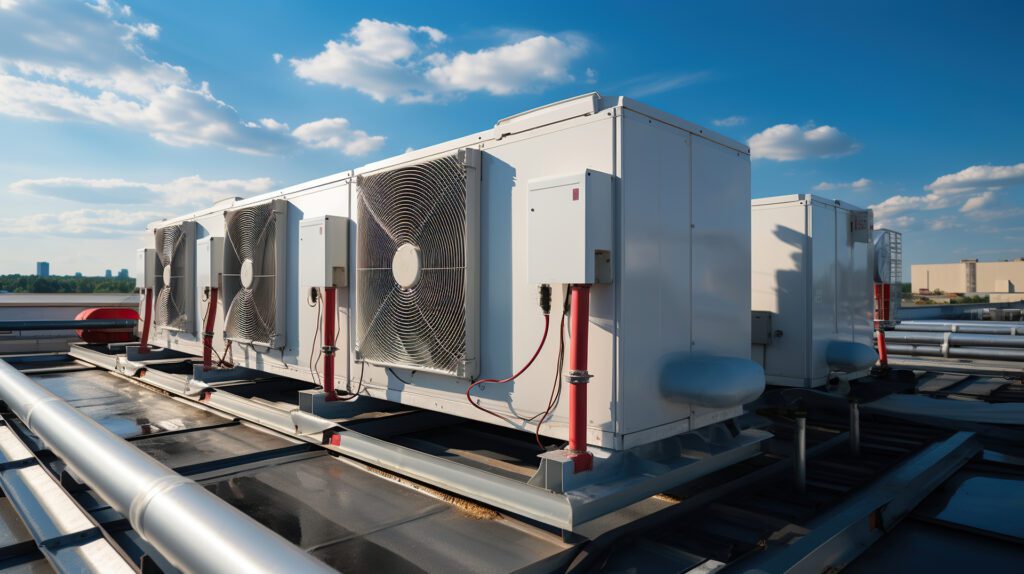
VRF (Variable Refrigerant Flow), also known as VRV (Variable Refrigerant Volume), is a refrigerant-based air conditioning architecture in which one or more outdoor condensing units serve many indoor units through a shared refrigerant piping network. The compressors modulate capacity continuously — typically via inverter-driven scroll or rotary machines — matching total output to the actual aggregated load of all connected indoor units.
Key components of VRF HVAC systems include:
- Outdoor condensing unit(s) with inverter-driven compressor(s)
- Refrigerant piping network with branch selectors and joints
- Indoor units — cassette, wall-mounted, ducted, concealed, floor-standing
- Individual zone controllers and a central control interface
- Optional heat recovery branch boxes
Heat Pump vs Heat Recovery VRF
Heat pump VRF systems serve all indoor units in the same mode — either all cooling or all heating — at any given time.
Heat recovery VRF systems allow simultaneous heating and cooling across different zones, routing heat from zones being cooled to zones being heated. This is particularly valuable in mixed-use buildings where interior zones need cooling while perimeter zones need heating, and in hotels where occupied rooms have different needs than corridors.
Why VRF Suits Saudi Arabia
Part-Load Efficiency
Buildings rarely run at full load. VRF systems excel at 20 %–60 % of design load — exactly where they spend most of their operating hours. Inverter compressors modulate capacity smoothly, avoiding the on-off cycling losses of fixed-speed systems.
Tight Integration with Tenant Fit-Out
Commercial buildings in Saudi Arabia often deliver a core-and-shell with VRF backbone, then let tenants connect their indoor units as they fit out their spaces. This avoids both oversizing and undersizing the central plant before the tenant mix is known.
Quiet Operation
Inverter compressors ramp smoothly, and indoor units operate at low sound levels — an important advantage in hotels, offices, and healthcare environments where ambient noise matters.
Compact Footprint
VRF HVAC systems concentrate outdoor equipment on rooftops or designated exterior spaces, freeing valuable floor area compared with AHU rooms or chiller plants. For urban infill and renovation projects, this is often decisive.
Flexibility and Phased Installation
Indoor units can be added, moved, or changed without replacing the whole system. This suits multi-tenant buildings, phased occupancy, and buildings that evolve over time.
Applications of VRF HVAC Systems in Saudi Arabia
- Hotels and serviced apartments — individual guest room control with efficient central equipment
- Mid-rise office buildings — tenant-specific zoning without large central plants
- Retail outlets and boutiques — flexible indoor unit placement, quiet operation
- Schools, universities, and training centers — zone control, phased operation across academic hours
- Clinics and small healthcare facilities — precise zone temperature with IAQ coordination
- Restaurants, cafes, and food service — effective cooling with heat recovery for kitchens
- Villas and luxury residences — whole-home systems with individual room control
Designing VRF Systems for Saudi Arabia’s Climate
Ambient Derating
Outdoor VRF condensing units lose capacity as ambient temperature rises. Manufacturer catalog values are typically published at 35 °C outdoor; at 45 °C and above, actual capacity can drop 10 %–20 %. Proper selection uses site-specific design temperatures — not lab values.
Pipe Length and Height Limitations
Every VRF manufacturer imposes limits on maximum refrigerant pipe length, height difference between outdoor and indoor units, and maximum distance from branch to furthest indoor unit. Exceeding these limits degrades capacity and efficiency. A competent designer verifies every configuration against manufacturer guidelines.
Refrigerant Safety
With larger refrigerant charges than split systems, VRF HVAC systems must comply with ASHRAE 15, EN 378, and local code requirements for refrigerant concentration limits in occupied spaces. R-32 and low-GWP refrigerants are increasingly specified for new projects.
Ventilation
VRF serves sensible and latent cooling but does not inherently bring in outside air. A complete system includes a dedicated outside air supply (typically DOAS with energy recovery) to meet ventilation requirements per ASHRAE 62.1 and SBC 501.
Condensate Management
Multiple indoor units mean multiple condensate drains. Proper slope, trapping, and tie-in to building drainage prevent leaks and biological growth. In humid coastal locations such as Jeddah and Dammam, careful condensate design is critical.
Controls and BMS Integration
Modern VRF manufacturers offer BACnet, Modbus, and LonWorks gateways that integrate VRF control with building BMS platforms. This enables scheduling, setback, demand response, and unified energy reporting across the building.
Installation Best Practices
Refrigerant Piping
VRF refrigerant lines demand specialist workmanship:
- Clean copper with internal nitrogen purge during brazing
- Oxygen-free nitrogen pressure testing to manufacturer specifications
- Deep vacuum triple evacuation before refrigerant charge
- Proper pipe support spacing and insulation
- Documented leak testing and commissioning records
A poorly installed VRF system can pass initial startup and then develop oil return, capacity, or reliability issues months later.
Indoor Unit Placement
Ceiling cassettes require careful coordination with grid ceilings, lighting, and sprinklers. Ducted concealed units need adequate static pressure budget and serviceable access panels. Wall-mount units need space for installation, air throw, and filter access.
Outdoor Unit Location
Outdoor units need:
- Unobstructed airflow to both intake and discharge
- Shade or solar protection where feasible
- Easy maintenance access
- Protection from direct sand and dust exposure
- Proper structural support and vibration isolation
Condensate and Refrigerant Alarms
Well-designed systems include condensate overflow sensors, refrigerant leak detection for large assemblies, and integration with building alarms.
Operating Economics and Maintenance
VRF HVAC systems deliver strong lifecycle economics when properly maintained. Typical maintenance includes:
- Quarterly filter cleaning or replacement at indoor units
- Annual coil cleaning (indoor and outdoor)
- Refrigerant pressure and temperature verification
- Electrical connection checks and capacitor health
- Control and communication bus integrity checks
- Drain pan and condensate line cleaning
A well-maintained VRF system delivers 15–20 years of reliable service.
VRF vs Chilled Water: Which Is Right for Your Building
VRF is usually the right answer for buildings from roughly 50 tons up to 300 tons, where tenant zoning and installation flexibility matter. Above that capacity, or where redundancy requirements are very high, chilled water plants typically regain the advantage. Hybrid buildings with VRF on some floors and chilled water on others are common in mixed-use developments.
A professional HVAC contracting company in Saudi Arabia evaluates building use, floor plate, operating hours, and long-term flexibility before recommending VRF, chilled water, or a hybrid architecture.
Execute Your VRF Project with the Right Partner
VRF installation quality determines long-term performance more than the equipment brand itself. Look for an execution partner with:
- Manufacturer-certified VRF designers and technicians
- Strong refrigerant piping workmanship
- Documented commissioning and testing procedures
- Local service presence across Jeddah, Riyadh, Dammam, and other major cities
- Long-term maintenance capability and genuine spare parts
Saudi ProTech delivers complete execution of VRF HVAC systems across Saudi Arabia — design review, installation, commissioning, BMS integration, and long-term service — for commercial, hospitality, retail, and institutional clients.
Talk to Our HVAC Team
If your project is evaluating VRF against other HVAC architectures, or planning a new VRF installation, our team can walk through the trade-offs for your specific building and use case.
Contact Saudi ProTech to discuss your project or request a preliminary VRF design and budget.