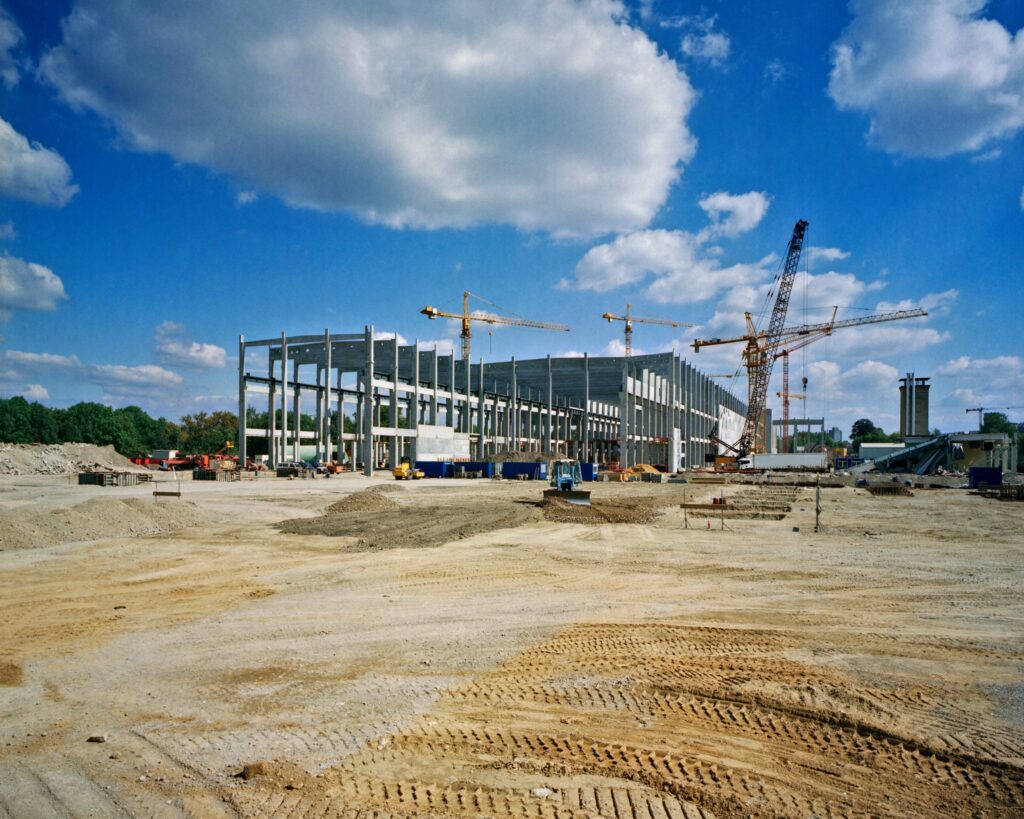
Saudi hospital expansion increasingly happens through renovation of existing facilities rather than greenfield builds. The two paths have very different cost, schedule, risk and operational profile. Working reference for hospital owners and PMs deciding between expansion modes.
When renovation makes sense
- Existing facility has capacity-utilized envelope but underused or outdated departments
- Catchment area doesn’t justify a new hospital
- Site constraints (urban location, no adjacent land)
- Existing brand and operational continuity have value
- Phased expansion through repeated renovation cycles fits the operational rhythm
When greenfield wins
- Adding capacity that the existing site can’t accommodate
- New service line incompatible with existing layout (e.g., trauma center addition)
- Existing facility too old or too compromised to renovate economically
- Land available adjacent or in a strategic location
- Vision 2030 / NHSA strategy designates a new facility for the catchment
Cost comparison
Per-bed cost comparison varies widely with service mix, but typical Saudi ranges:
- Greenfield general hospital: SAR 2.5M – 5M per bed all-in (excluding land and major equipment)
- Major renovation: SAR 1.5M – 3.5M per bed when reusing significant structure and MEP
- Specialty department renovation (OR suite, ICU): often more expensive per m² than greenfield because of phasing constraints
- Comprehensive hospital expansion (add wing to existing facility): SAR 3M – 5M per added bed with significant interface costs
Schedule comparison
- Greenfield 200-bed: 36-54 months from concept to opening
- Major renovation of 200-bed facility: 36-48 months with significant phasing
- Single OR suite renovation: 9-18 months
- Single ward renovation: 6-12 months
The phasing challenge on operational sites
Renovation while the hospital operates is the single biggest source of cost and schedule pressure. Phasing strategy must address:
- Patient flow continuity — patients can’t pass through a construction zone; alternative routing must be planned
- Service relocation — affected services move to temporary or alternative spaces during renovation
- Utility continuity — water, electrical, HVAC, medical gas to operating departments cannot interrupt
- Infection control (ICRA) — discussed above; non-negotiable
- Noise and vibration limits — restrictions on impact work near patient care; off-hours work scheduling
- Clinical and operational staff communication — daily coordination on access, deliveries, work hours
Common renovation programme mistakes
- Underestimating the temporary swing-space requirement (where do current services go during renovation?)
- Discovering hidden conditions (asbestos, code-non-compliant electrical, structural surprises)
- Assuming utility connections without verifying capacity
- Underestimating ICRA disruption to adjacent operations
- Late discovery that the existing structural system can’t carry new equipment loads (MRI, CT)
Pre-renovation due diligence
Successful renovation projects start with comprehensive due diligence:
- Existing condition survey (as-builts often inaccurate; verify in field)
- Hidden conditions investigation (selective demolition, ceiling and wall opening)
- Structural capacity assessment for new equipment loads
- MEP capacity assessment and tie-in planning
- Hazardous materials survey
- Operational impact assessment with clinical leadership
Where this fits
Our hospital construction team in Saudi Arabia handles greenfield and renovation healthcare projects, including phased work on operational sites. If you’re at the strategic decision stage between expansion modes, we can support the trade-study.