Why industrial roofs are Saudi Arabia’s best solar asset
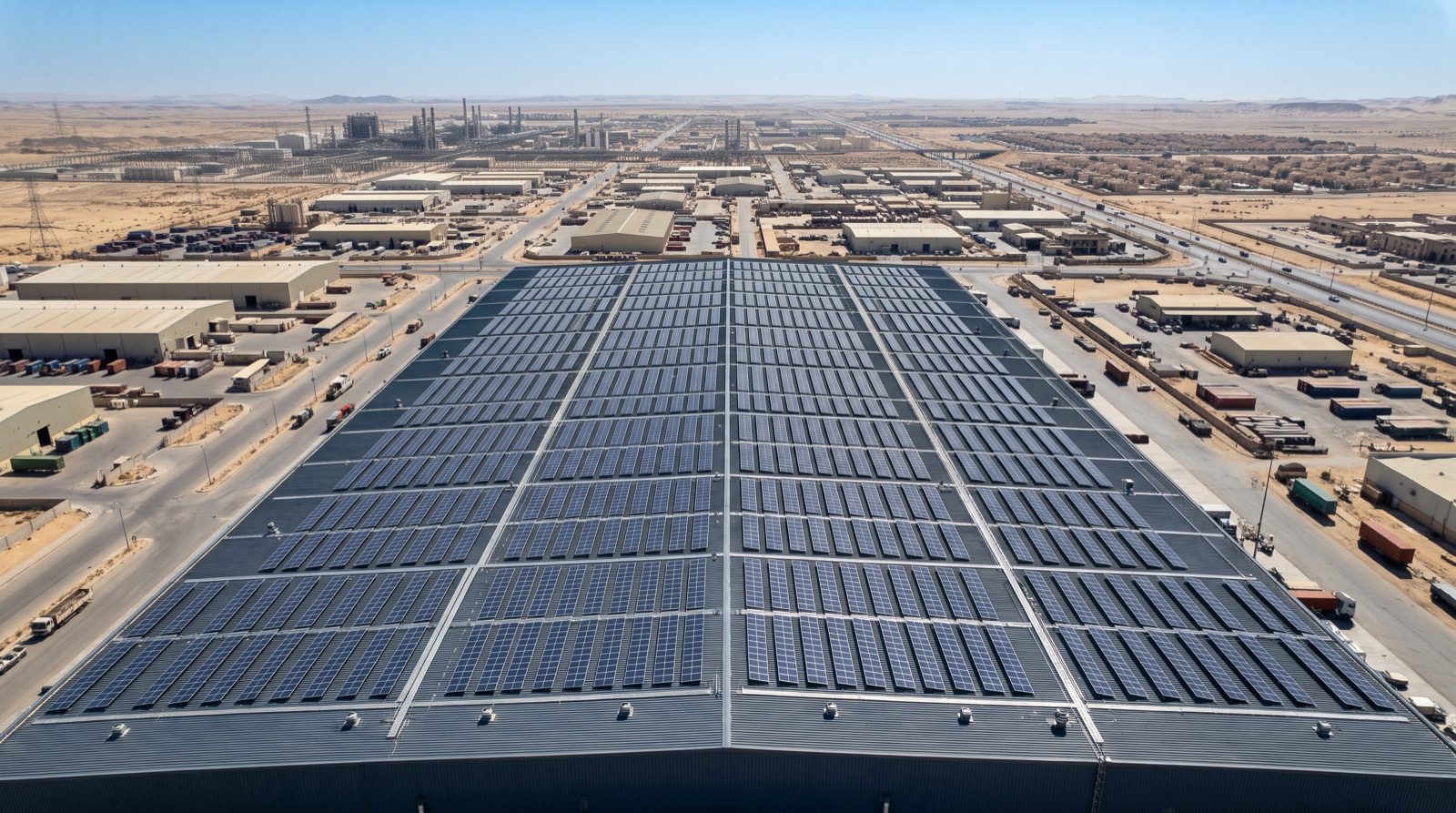
Saudi Arabia has some of the highest solar irradiation in the world, and factories and warehouses have exactly what solar needs: large flat or low-pitch roofs and heavy daytime electricity demand from cooling, compressors and production lines. The question owners ask is not “does solar work?” but “how fast does it pay back?”. This guide shows how a professional solar systems contractor in Saudi Arabia calculates it, so you can check any proposal you receive.
Step 1: Understand your load profile
Collect 12 months of electricity bills and, ideally, interval (hourly) meter data. Solar is most valuable when the energy is used on site during the day. A factory running one or two day shifts, or a cold store with constant refrigeration load, is ideal. Size the system so most of its output is self-consumed. Oversizing beyond daytime demand only pays if exported energy is credited under net metering.
Step 2: Estimate annual yield
Annual energy (kWh) = system size (kWp) × specific yield (kWh/kWp/year).
Specific yield in Saudi Arabia is high, but it is reduced by heat (panel temperature losses), dust soiling, inverter losses and orientation. A proper design uses simulation software with local weather data rather than a rule of thumb, and should state the assumed soiling losses and cleaning frequency.
Step 3: Value the energy
Annual savings = self-consumed kWh × your applicable SEC tariff + exported kWh × export credit (if net metering applies).
Use the current SEC tariff for your customer category (industrial or commercial) and consumption bracket. Do not use an average from a brochure. If you are on a tiered tariff, value solar at the tier it displaces.
Step 4: Count the full cost
- Panels, inverters, mounting structure, DC/AC cabling and protection.
- Roof works: structural verification, waterproofing penetrations and walkways.
- Grid connection: SEC application under the small-scale solar regulations, metering and protection settings.
- Monitoring system and safety (fire-safe DC isolation, labelling).
- O&M over 25 years: panel cleaning, inspections and inverter replacement around mid-life.
Step 5: Calculate payback and lifetime value
Simple payback (years) = total installed cost ÷ annual net savings (savings minus annual O&M).
Also look at the 25-year view, including panel degradation (typically around 0.4–0.6% per year for modern modules), inverter replacement and tariff changes. A good proposal shows payback, internal rate of return (IRR) and cumulative cash flow.
Check the roof before anything else
Many older warehouse and pre-engineered steel buildings were not designed for the extra dead load and wind uplift of PV arrays. Before signing:
- Get a structural check of purlins and frames for the added load.
- Check the roof sheeting’s age. If it needs replacing within 10 years, replace it before installing solar.
- Plan safe access for cleaning: walkways, lifelines and water points.
For new facilities, design the roof for solar from the start as part of the factory construction scope. It costs far less than reinforcing later.
Dust: the factor that makes or breaks payback
Dust can cut output significantly within weeks in Saudi industrial zones. Budget for regular cleaning (manual, semi-automatic or robotic), and monitor output per string so dirty or faulty sections are spotted quickly.
Frequently asked questions
What size solar system does a factory need?
It is sized to the daytime load and the available roof area, not the total monthly bill. A load-profile analysis determines the optimum kWp.
Can I export excess solar power to SEC?
Small-scale grid-connected systems can apply for connection and net billing under the applicable regulations. Check current limits and conditions for your connection category.
How long do solar panels last in Saudi heat?
Quality modules carry 25–30-year performance warranties. Inverters typically need replacement once during that period.
Get a solar feasibility study
ProTech designs, installs and maintains rooftop solar PV for factories, warehouses and commercial buildings across Saudi Arabia. Send us your electricity bills for a free first-pass payback estimate.