A refrigeration plant only delivers on its business case when it is installed and commissioned to the same standard at which it was designed. Too many facilities in Saudi Arabia run below their intended efficiency, or develop chronic reliability issues, not because the equipment was wrong — but because industrial refrigeration installation in saudi arabia was rushed, under-supervised, or executed without the specialist expertise that refrigeration demands.
This article outlines how a professional industrial refrigeration installation should be executed in Saudi Arabia, from pre-installation planning through commissioning and handover.
Why Installation Quality Defines Plant Performance
Refrigeration plants are unusually sensitive to execution quality. A single poorly welded joint, misaligned pipe, undersized return line, or incorrectly wired control can undermine the entire investment. Common consequences of poor installation include:
- Chronic capacity shortfalls during peak summer operation
- Excessive energy consumption — 10 % to 25 % above design
- Oil return problems that damage compressors over time
- Moisture or non-condensable contamination that degrades performance
- Recurring leaks, vibration, and maintenance costs
- Safety issues that emerge months or years after startup
A disciplined industrial refrigeration installation prevents these problems by doing the right things — properly — at every stage.
Pre-Installation Planning
The foundation of a successful installation is the work done before any equipment arrives on site.
Design Review and Constructability
A good execution partner reviews the design with a fresh set of eyes before construction starts. This catches issues early:
- Equipment selection against realistic design-day conditions
- Piping layout for oil return, pressure drop, and serviceability
- Structural support loads including operating and maintenance weights
- Electrical coordination and breaker selection
- Control logic and instrumentation coverage
- Safety valve sizing, discharge routing, and gas detection coverage
- Code compliance against applicable Saudi and international standards
Logistics and Sequencing
Large industrial refrigeration plants involve heavy equipment, long lead-time components, and tight site access. A well-planned industrial refrigeration installation includes:
- Lifting and rigging plans for major equipment
- Delivery sequencing matched to installation progress
- Protected storage for refrigerants, oil, and sensitive electronics
- Coordination with other trades — electrical, civil, structural, controls
Documentation and Quality Plan
Quality documentation should be established before work begins:
- Welding procedures and welder qualifications
- Pipe support and insulation standards
- Pressure test and leak test plans
- Inspection and test plans (ITPs)
- Punch list and handover protocols
Mechanical Installation Best Practices
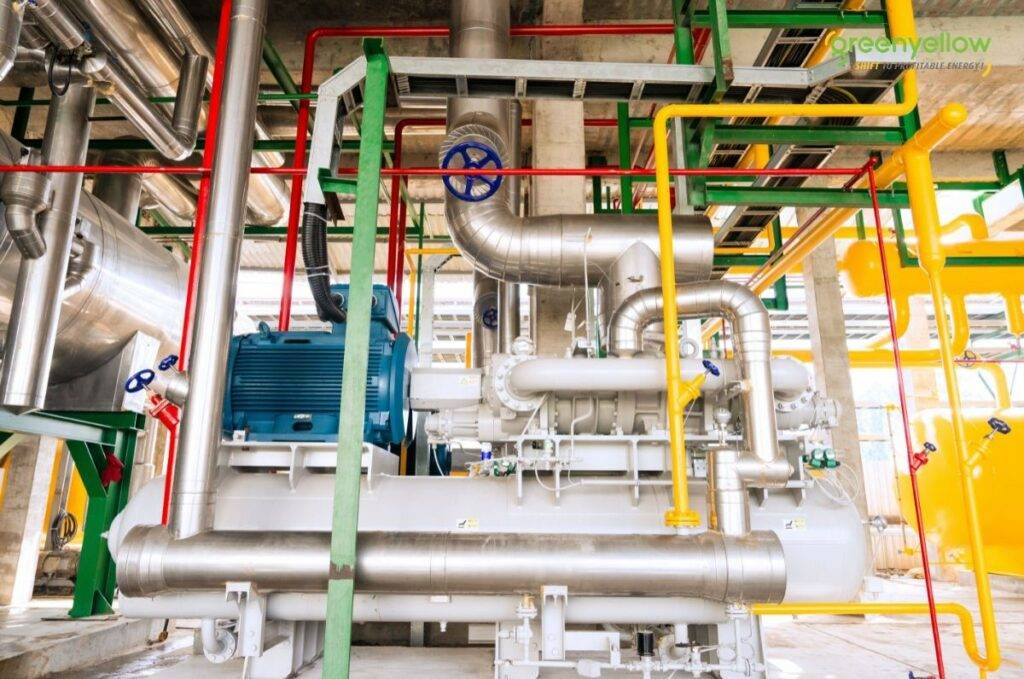
Piping and Welding
Refrigeration piping deserves the same rigor as pressure piping elsewhere. Key practices include:
- Qualified welders working to documented procedures
- Internal cleanliness and dry nitrogen purging during welding
- Correct support spacing with thermal movement accommodation
- Properly designed oil return traps and suction risers
- Slope and low-point drainage for liquid lines
- Vibration isolation at compressor connections
Equipment Setting and Alignment
Compressors, condensers, pumps, and pressure vessels must be set level, aligned, and anchored to shop drawings. Vibration isolation, base grouting, and shaft alignment all affect long-term reliability.
Insulation
In Saudi Arabia’s climate, insulation quality is a major efficiency factor. Closed-cell elastomeric or polyurethane insulation with proper vapor sealing, UV-resistant cladding, and clean terminations keeps cold surfaces cold and prevents long-term moisture damage.
Electrical, Controls, and Instrumentation
An industrial refrigeration installation is as much an electrical and control project as a mechanical one.
Power Distribution
Properly sized cables, motor control centers, and VFDs are matched to compressor starting characteristics and harmonic considerations. Cable routing avoids heat sources and mechanical damage paths.
Controls and PLC
Modern refrigeration plants rely on PLC-based control with dedicated operator stations, BMS integration, and remote access. Good installation includes:
- Clearly labeled I/O points and documented wiring
- Proper grounding and shielding for analog signals
- Tested communication links with redundancy where critical
- Operator interface designed for real-world use
Instrumentation
Pressure transmitters, temperature probes, flow meters, level sensors, and gas detectors must be installed per manufacturer guidance and calibrated at commissioning. Poor installation of instruments can mask real problems and give false confidence in plant operation.
Pressure, Leak, and Vacuum Testing
Before any refrigerant is introduced, the system must prove it is tight and clean.
Pressure Test
Every refrigerant circuit should be pressure tested with dry nitrogen to the applicable test pressure, typically 1.1× to 1.25× the design pressure, held long enough to detect leaks.
Leak Test
After pressure test, a sensitive leak test — often with a trace gas such as helium or dedicated electronic leak detection — finds micro-leaks that pressure testing alone cannot.
Vacuum and Dehydration
Triple evacuation to deep vacuum removes moisture and non-condensables. Skipping this step is a leading cause of long-term performance loss.
Refrigerant Charging and Initial Startup
Once the system is tight and evacuated, charging and startup begin:
- Refrigerant is charged to calculated quantity, respecting local handling regulations
- Oil levels are verified
- Compressors are rotated, alignment rechecked, and protection settings verified
- Control loops are simulated and tuned
- Safety systems — pressure reliefs, gas detection, ventilation, interlocks — are tested
A careful startup prevents the damage that rushed commissioning often causes.
Commissioning and Performance Verification
Commissioning is where an industrial refrigeration installation earns its reputation.
Functional Testing
Every pump, valve, sensor, and control loop is exercised against a documented checklist. Alarms and interlocks are verified to trip at correct setpoints.
Capacity and Efficiency Testing
The plant is loaded progressively and tested against design capacity and efficiency. Measurements are compared with design expectations and variances investigated.
Trending and Baseline
Operating data is trended over multiple days to confirm stable control, proper part-load behavior, and absence of hunting or cycling.
Documentation Handover
The commissioning package includes:
- As-built drawings
- Pressure and leak test certificates
- Refrigerant and oil records
- Functional test and capacity test reports
- Alarm and trip setpoint lists
- O&M manuals and training records
Operator Training
Even the best plant underperforms if operators are not trained to run it. A thorough industrial refrigeration installation includes:
- Classroom and on-site training on refrigeration fundamentals
- Plant-specific operating procedures
- Emergency response drills — especially for ammonia systems
- Maintenance planning and basic troubleshooting
- Logbook and data recording practices
Warranty, Service, and Long-Term Support
Handover is not the end of the relationship. A serious execution partner provides:
- Warranty service and rapid response to startup issues
- Spare parts availability across major Saudi cities
- Scheduled maintenance contracts
- Performance reviews and energy audits at 6, 12, and 24 months
- Upgrade path as production demand grows
Executing Your Project in Saudi Arabia
Industrial refrigeration installation in Saudi Arabia has its own realities — climate, logistics, regulatory environment, and workforce. An effective execution partner brings:
- Proven refrigeration experience across food, dairy, beverage, cold storage, pharmaceutical, and petrochemical sectors
- Local offices and service capability in Jeddah, Riyadh, Dammam, and other major cities
- Integrated MEP delivery so refrigeration, electrical, controls, and plant services are coordinated
- Strong QA/QC and safety cultures
- Transparent project management and documentation
- Long-term commitment to client success
Saudi ProTech provides end-to-end execution of industrial refrigeration installation projects across Saudi Arabia — ammonia, NH3/CO2 cascade, glycol, and process cooling systems — from design review through commissioning and handover, supported by ongoing maintenance and service.
Start Your Industrial Refrigeration Project
Whether you are planning a new refrigeration plant, adding capacity, or replacing aging equipment, the quality of installation will shape operating cost, reliability, and safety for decades. Choosing a capable execution partner is one of the most consequential decisions on the project.
Contact Saudi ProTech’s industrial refrigeration team to discuss your project, arrange a design review, or schedule a site visit to assess your requirements.