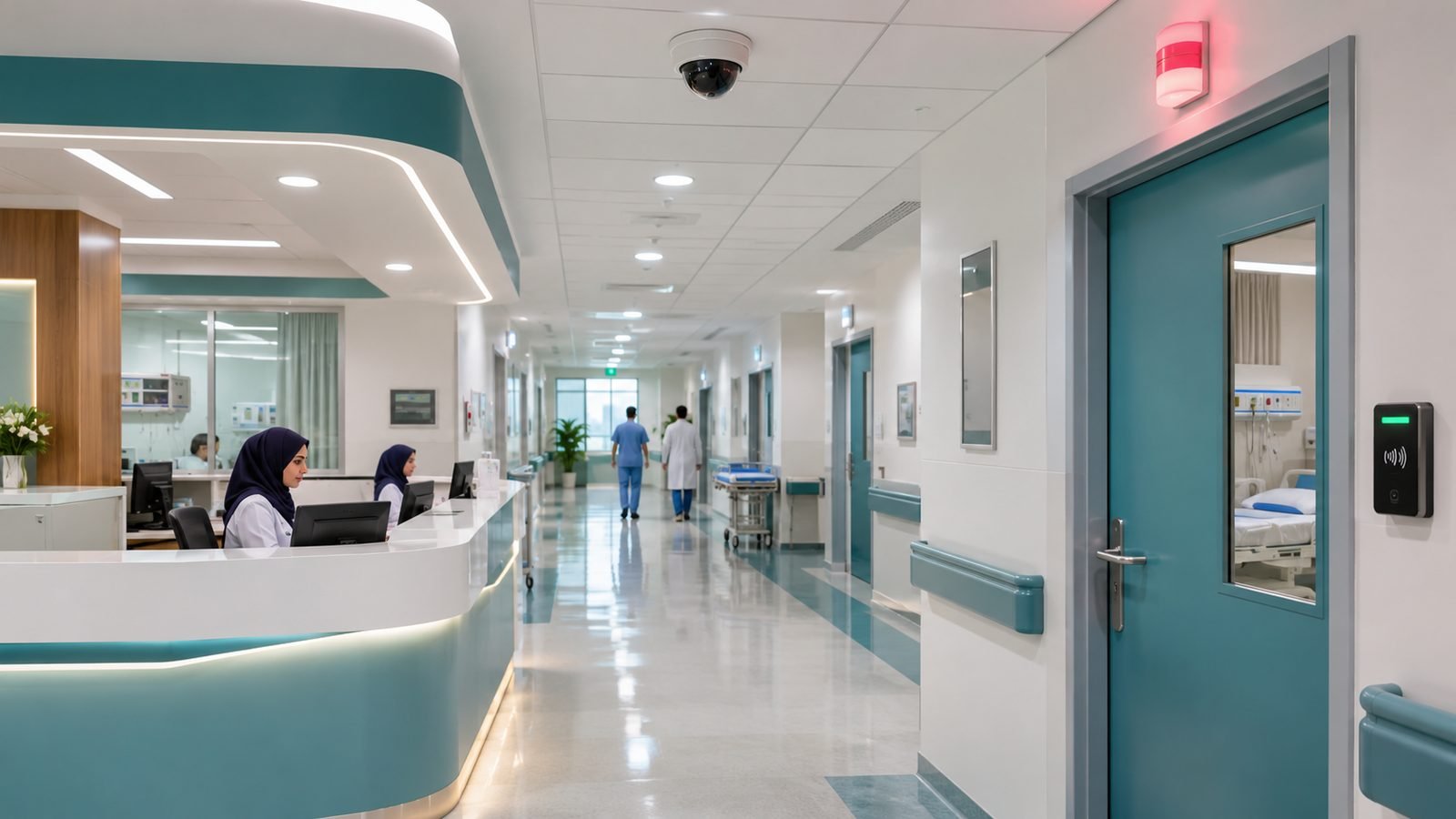
Why hospitals depend on low-current systems
A hospital runs on far more than power and air conditioning. Patients call nurses, doctors are paged, infants are tagged, pharmacies are secured, and isolation rooms are kept at the right pressure. All of this runs on extra-low-voltage, or “low-current”, systems. In Saudi healthcare projects these systems are often the most complex part of the MEP package, and the most likely to be under-designed. As a low current contracting company in Saudi Arabia, we break down the systems a modern hospital needs and how they should work together.
The core low-current systems in a hospital
Nurse call system
Bedside, toilet and bath pull-cord stations, corridor dome lights and nurse-station displays, ideally IP-based so calls can be routed to nurses’ phones. Emergency and code-blue calls need distinct priority, and every call should be logged for response-time audits.
Structured cabling and network
The backbone for medical devices, HIS/PACS, IP phones, Wi-Fi and IP-based security. Hospitals need high-category copper, fibre backbones, redundant core switches and properly cooled IDF rooms, designed for growth.
CCTV
Coverage of entrances, emergency departments, pharmacies, car parks and corridors, with privacy masking in clinical areas and retention that meets regulatory requirements.
Access control
Card or biometric control for operating theatres, ICU, pharmacies, medical records, labs and server rooms, integrated with the fire alarm so doors fail safe during evacuation.
Infant protection and patient tracking
RFID tags with door-lock integration in maternity wards, and RTLS for high-value equipment and wandering patients.
Public address and voice evacuation
Zoned paging for staff announcements, integrated with the fire alarm for phased evacuation, which is critical where patients cannot be moved quickly.
Building management system (BMS)
Monitors AHUs, chillers, isolation-room pressure, medical-gas alarms, generators and UPS. In hospitals the BMS is a patient-safety system, not just an energy tool.
IPTV, queue management and clocks
Patient entertainment, waiting-area queue displays and synchronised master clocks for operating theatres.
Integration: where most hospital projects fail
Each system is often bought from a different vendor, so they end up unable to talk to each other. Plan integration from day one:
- Fire alarm → access control, PA, BMS, lifts: doors release, evacuation messages play, AHUs and smoke dampers respond, lifts home.
- Nurse call → staff phones / RTLS: calls follow the assigned nurse.
- Infant tagging → access control and CCTV: an alarm locks exits and calls up the camera.
- All systems → one converged network with VLAN separation and cybersecurity hardening.
Planning installation in a live or new hospital
- Freeze the clinical brief early: bed numbers, departments, isolation rooms and theatres drive every system.
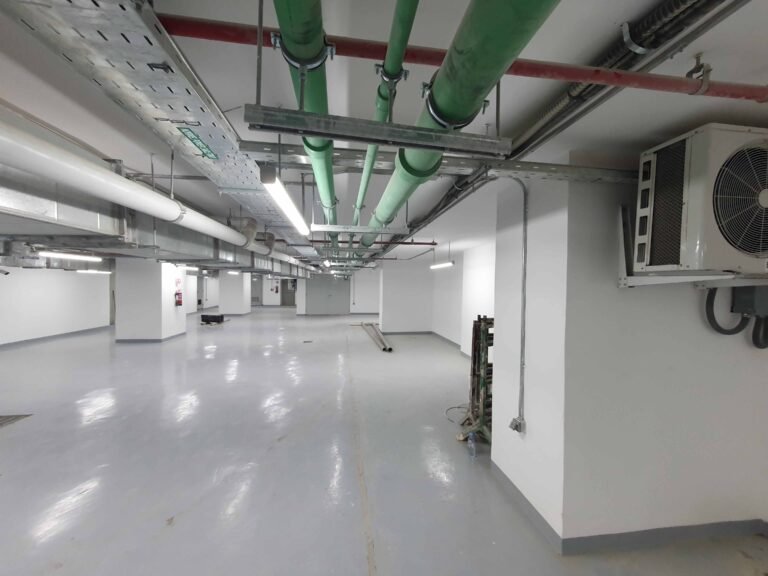
- Coordinate containment (trays, conduits, back boxes) with the ceiling and MEP layouts before construction.
- Size IDF/MDF rooms with cooling and UPS at the design stage, not afterwards.
- In live hospitals, phase work by department, with infection-control measures such as dust barriers and negative-pressure enclosures.
- Commission and test every interface, then train clinical and FM staff.
For new healthcare buildings, low-current design should be coordinated within the overall hospital construction programme so containment and rooms are built in, not retrofitted.
Maintenance after handover
Batteries in nurse-call and PA systems, camera storage, firmware updates and access-control databases all need regular attention. Include low-current systems in the hospital’s MEP maintenance contract with defined response times for critical failures.
Frequently asked questions
What are low-current systems in a hospital?
Extra-low-voltage systems such as nurse call, structured cabling, CCTV, access control, PA/voice evacuation, BMS, infant tagging, IPTV and master clocks.
Should hospital low-current systems be IP-based?
For new hospitals, IP-based systems on a converged network are the norm. They simplify integration, remote monitoring and future expansion.
Can you upgrade nurse call in an operating hospital?
Yes. Work is phased ward by ward, with the old system kept live until each area is switched over and tested.
Talk to our low-current team
ProTech designs, installs and maintains low-current systems for hospitals, clinics and commercial buildings across Saudi Arabia. Contact us to discuss your project.