For industrial facilities that need deep freezing at −40 °C or lower, a conventional single-refrigerant plant often runs into efficiency and safety limits. The NH3/CO2 cascade refrigeration system in Saudi Arabia solves this by pairing two natural refrigerants — ammonia on the high-temperature side and CO2 on the low-temperature side — in a single, integrated design. The result is efficient, compact, and future-proof low-temperature cooling that is increasingly specified in Saudi Arabia’s cold storage, food processing, and frozen distribution projects.
This article explains how NH3/CO2 cascade systems work, where they deliver the biggest advantages, and what to consider when planning a project in the Kingdom.
What Is an NH3/CO2 Cascade Refrigeration System
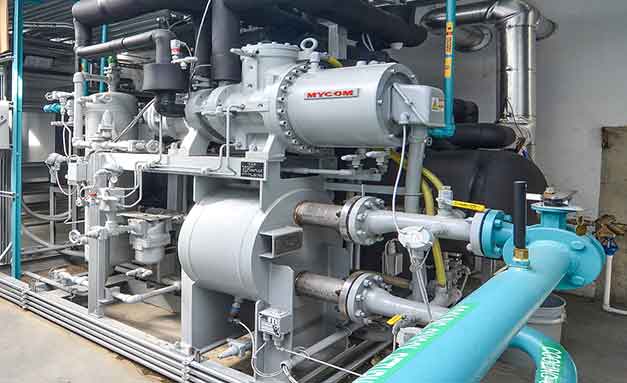
A cascade refrigeration system uses two separate refrigeration circuits. A high-temperature circuit rejects heat to the ambient environment (usually through evaporative or air-cooled condensers), while a low-temperature circuit provides the actual process cooling. The two circuits exchange heat through a cascade heat exchanger.
In an NH3/CO2 cascade refrigeration system, the configuration is specifically:
- High-temperature side: ammonia (R-717) — efficient, environmentally clean, well suited to hot ambient conditions.
- Low-temperature side: carbon dioxide (R-744) — non-toxic, low viscosity, excellent heat transfer, and very efficient at temperatures below −30 °C.
The cascade condenser is where CO2 gives up its heat to the boiling ammonia. From the user’s perspective, CO2 delivers the cold; ammonia carries that heat out to the atmosphere.
Why Use an NH3/CO2 Cascade Refrigeration System
Several operational realities make NH3/CO2 cascade the preferred solution for deep-freeze applications in Saudi Arabia.
Superior Efficiency at Low Temperatures
Below around −30 °C, single-stage ammonia plants require very large compressor displacements and high pressure ratios, which hurts efficiency and reliability. CO2 on the low side, operating at relatively high suction pressures, keeps compressor size and power draw reasonable — and a well-designed NH3/CO2 cascade refrigeration system can reduce energy consumption by 15 % to 25 % compared with a two-stage ammonia plant at the same duty.
Reduced Ammonia Charge
Because CO2 handles all low-temperature distribution — including to cold rooms, blast freezers, and evaporators — the ammonia charge stays concentrated in a compact plant room. This is a significant safety and compliance advantage for food plants and urban industrial sites, and it aligns with the global move toward low-charge ammonia refrigeration systems.
Safe Distribution Inside Production Areas
CO2 is non-toxic and non-flammable at the concentrations used in refrigeration circuits. That makes it safe to run inside production halls, cold rooms, and process areas, where keeping ammonia lines is often impractical.
Future-Proof Refrigerant Strategy
Both refrigerants are natural, with zero ODP and negligible GWP. An NH3/CO2 cascade refrigeration system is not exposed to the phasedown schedules affecting HFC and HFO blends.
Typical Applications for NH3/CO2 Cascade Systems
In Saudi Arabia, NH3/CO2 cascade refrigeration is particularly well suited to:
- Frozen food and seafood processing — where blast freezing and hardening rooms run at −35 °C to −40 °C.
- Ice cream and dairy — requiring precise temperature control between −25 °C and −40 °C.
- Frozen distribution centers — with multiple cold and frozen zones served from a single plant room.
- Meat and poultry processing — combining chilling, freezing, and storage loads.
- Pharmaceutical and biotech cold storage — where strict temperature stability is critical.
Key Design Considerations for an NH3/CO2 Cascade Refrigeration System
Delivering the promised efficiency and reliability requires careful system design.
Cascade Condenser Selection
The cascade heat exchanger is the heart of the system. Plate-shell or fully welded plate heat exchangers are typical, sized for a small approach temperature (3–5 K) to maximize efficiency. Oversizing the cascade condenser is one of the simplest ways to reduce overall plant power consumption.
CO2 Circulation Strategy
The CO2 side can be pumped, direct expansion (DX), or volatile secondary. Pumped CO2 systems are the most common for large cold storage and multi-zone plants because they provide stable, flooded-evaporator heat transfer and flexible control.
Standby and Pressure Management
CO2 operates at much higher pressures than ammonia. When the plant shuts down, rising temperature causes CO2 pressure to climb rapidly. Every NH3/CO2 cascade refrigeration system must include a reliable standby strategy — typically a small auxiliary condensing unit or a vented safety path — so that pressure stays within safe limits during outages.
Insulation and Pipe Sizing
CO2 lines are smaller than equivalent ammonia lines because of the refrigerant’s high density, but insulation quality is critical. Poorly insulated CO2 piping in a warm plant room can quickly drive up running costs.
Controls and Monitoring
A modern NH3/CO2 cascade refrigeration system relies on integrated PLC control, VFDs on compressors and condenser fans, and remote monitoring. Good control strategy — floating head pressure, suction pressure optimization, defrost coordination — is where most of the real-world efficiency gains come from.
Operating and Lifecycle Advantages
Over a 15–20 year lifecycle, NH3/CO2 cascade refrigeration systems offer operators several tangible benefits:
- Lower annual energy cost versus two-stage ammonia or HFC alternatives at deep-freeze temperatures.
- Reduced refrigerant inventory, simplifying safety management and insurance.
- Natural refrigerants with stable, low-cost supply and no phasedown exposure.
- Robust performance in hot ambient conditions typical of Saudi Arabia.
- Compatibility with modern low-charge, skid-mounted, or modular plant concepts.
Execution in Saudi Arabia
Building an NH3/CO2 cascade refrigeration system in Saudi Arabia requires an execution partner familiar with local climate, codes, and site logistics. Key execution factors include:
- Selection and sizing of equipment for 45 °C+ design-day conditions
- Proper integration with electrical, controls, BMS, and plant-wide utilities
- Strict adherence to safety codes for both ammonia and high-pressure CO2
- Skilled welding, pressure testing, and commissioning for CO2 lines
- Operator training and documentation to support long-term reliable operation
Saudi ProTech executes NH3/CO2 cascade refrigeration systems for industrial clients across Saudi Arabia and its main cities, delivering design review, installation, commissioning, and long-term support under a single responsibility.
Moving Forward with Cascade Refrigeration
If your project requires deep-freezing, large cold storage volumes, or strict refrigerant safety — an NH3/CO2 cascade refrigeration system is often the most efficient, compliant, and future-proof solution available today.
Contact Saudi ProTech’s industrial refrigeration team to discuss load profiles, design options, and site-specific considerations for your project.