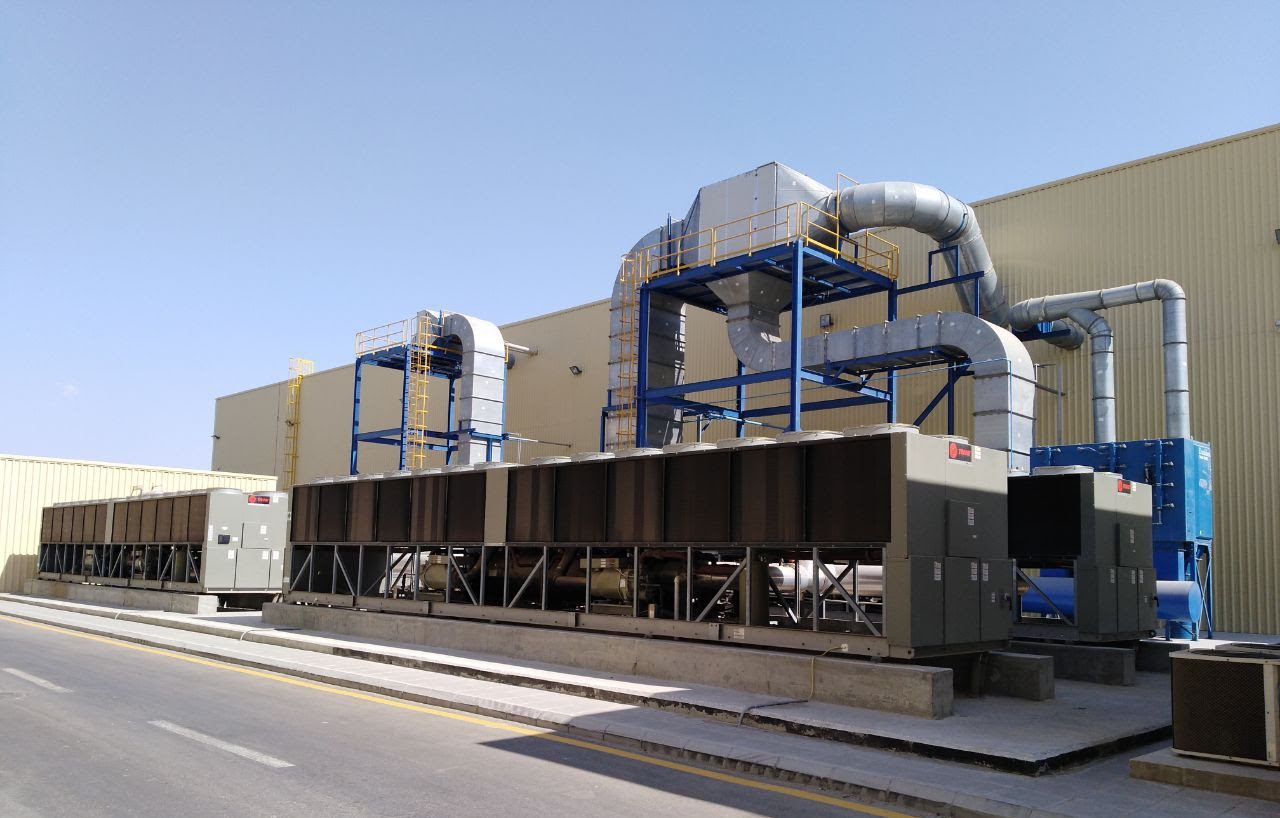
A chiller maintenance checklist is the simplest way to stop a chilled water plant from failing in the middle of a Saudi summer. Chillers here can run for most of the year at high load, often with high ambient temperatures, dust and, on the coast, humid salty air. Skipped checks show up first as higher electricity bills, then as high-pressure trips and, eventually, compressor failures.
Below is the practical checklist our HVAC maintenance engineers use as a starting point. Always follow the manufacturer’s service manual for your specific model; this list supplements it, it does not replace it.
Daily Checks (Operator Log)
Most chiller problems are visible in the numbers long before they become breakdowns. A simple daily log, kept by the facility operator or read from the BMS, should record:
- Chilled water supply and return temperatures, and the temperature difference (delta-T).
- Condenser water entering and leaving temperatures (water-cooled) or ambient temperature (air-cooled).
- Evaporator and condenser refrigerant pressures and saturation temperatures.
- Compressor amps, percentage load and running hours.
- Oil pressure and temperature, where the controller displays them.
- Any alarms, trips or unusual noise and vibration.
Trend these readings. A slowly rising condenser approach temperature, for example, usually means fouled tubes or poor cooling tower performance, and is far cheaper to fix early.
Monthly Checks
- Inspect for refrigerant and oil leaks at joints, valves and service ports; check the sight glass where fitted.
- Check electrical panels: tighten terminals as per the maintenance procedure, inspect contactors and look for overheating or discoloration.
- Clean or check strainers on chilled water and condenser water lines.
- Inspect air-cooled condenser coils for dust, sand and debris; clean as needed. In Riyadh and inland sites, this may be needed more often after dust storms.
- Check pumps: seals, bearings, vibration and noise, and that standby pumps rotate correctly.
- Review water treatment test results for the chilled water and condenser water loops.
- Verify the BMS sensors match local gauges.
Quarterly Checks
- Calibrate key temperature and pressure sensors.
- Check safety controls: high- and low-pressure cut-outs, flow switches, freeze protection and interlocks with pumps.
- Inspect insulation and vapour barriers on chilled water piping; damaged insulation causes condensation and corrosion, especially in Jeddah and the Eastern Province.
- Check vibration isolators and anti-vibration mounts.
- Review chiller sequencing and setpoints in the BMS to make sure chillers are not short-cycling or running at very low loads unnecessarily.
Annual (Major) Service
- Clean condenser tubes (water-cooled) by mechanical brushing; inspect and clean evaporator tubes as needed.
- Eddy-current test tubes on larger water-cooled machines, at the interval the manufacturer or insurer recommends.
- Take an oil sample for laboratory analysis and change oil and filters if indicated.
- Perform a refrigerant leak test and check the charge.
- Megger test compressor motors and inspect starters or VFDs.
- Deep-clean air-cooled condenser coils and check fans, belts and motors.
- Verify capacity and efficiency against the original commissioning data.
- Service the cooling tower; see our guide to cooling tower maintenance and water treatment.
Saudi-Specific Points Many Checklists Miss
Plan the major service before summer
Schedule tube cleaning, oil analysis and coil cleaning between roughly November and March, when cooling demand is lower and one chiller can be taken offline safely. Servicing in July leaves the plant without redundancy at peak load.
Dust and sand
Air-cooled chillers in inland locations lose capacity quickly when condenser coils clog. Set cleaning frequency by measured condition, not only by calendar.
Coastal corrosion
In Jeddah, Dammam and Khobar, inspect coil fins, casings, fasteners and electrical enclosures for corrosion, and repair coatings promptly.
Water quality
Make-up water quality varies by city and source. Poor treatment leads to scale on condenser tubes, which directly raises compressor power.
Signs Your Chiller Needs Attention Now
- The plant cannot hold chilled water setpoint on hot afternoons.
- Repeated high-pressure or low-pressure trips.
- Rising kW per ton of cooling compared with last year.
- Low delta-T across the evaporator, causing extra chillers and pumps to run.
- Oil loss, unusual compressor noise or vibration.
Frequently Asked Questions
How often should a chiller be serviced in Saudi Arabia?
Daily logging by operators, monthly and quarterly preventive checks, and one major annual service as a minimum. Critical facilities such as hospitals, data rooms and food plants usually need closer monitoring.
Can we do chiller maintenance in-house?
Operators can handle daily logs and basic monthly checks. Refrigerant work, oil analysis, tube testing and compressor work should be done by qualified chiller technicians.
Does maintenance really reduce energy costs?
Yes. Clean tubes, correct refrigerant charge, good water treatment and correct setpoints all reduce compressor power for the same cooling output.
Need a Chiller Maintenance Plan?
Saudi ProTech designs, installs and maintains chilled water plants across Saudi Arabia. Explore our chiller installation and maintenance services, read about chilled water energy optimization, or request a site survey. Teams serve Jeddah, Riyadh, Dammam and Khobar.